Gas is the common choice here
Utility gas heats 58.8% of occupied homes in Adams County. Electricity accounts for most of the rest, at 33.3%, and a smaller share of homes run on bottled or LP gas.
Takes about a minute. No obligation.
Utility gas heats 58.8% of occupied homes in Adams County. Electricity accounts for most of the rest, at 33.3%, and a smaller share of homes run on bottled or LP gas.
If your house already has a gas line run to the furnace, putting in another gas furnace is usually the straightforward job. Switching fuel types means new venting and new supply lines, which is a bigger project than a swap.
NOAA nClimDiv, 1991–2020 normals
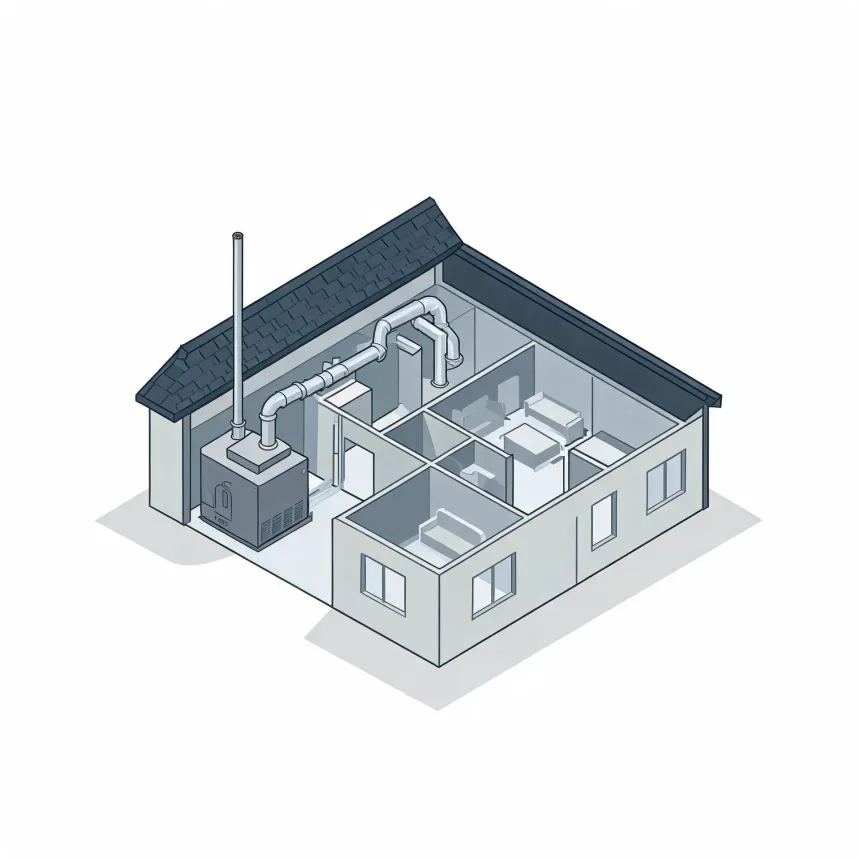
Winter nights here average 22°F, and the furnace runs October through April.
A correctly sized standard furnace handles that without needing extra capacity built in.



Half the homes in Quincy were built in 1965 or earlier. A lot of furnaces installed in those years were sized for a house that may have since gotten new windows, added insulation, or a finished basement. When a contractor sizes your replacement, they're running a load calculation on the house as it stands now, not pulling the number off the old unit's nameplate. An older house can also mean older ductwork, and a furnace has to move air through whatever ducts are already there. The install should match the house you actually have.
Natural gas ran $10.64 per million Btu in Illinois in 2024, on the cheaper side. That changes what's worth paying for. A high-efficiency furnace costs more up front and takes longer to earn that back when fuel is already inexpensive. Picking the right size and a model that holds up matters more here than chasing the highest efficiency number on the sticker.
Find a contractor
Ask the contractor to measure your ductwork before they quote a furnace size. The ducts already in your house were sized for whatever ran through them originally, and a new furnace has to move air through those same runs. A unit that's right for your square footage but wrong for your ducts will run loud, heat some rooms and miss others, or short cycle. Matching the furnace to the house means matching it to what's actually behind the walls, not just the load calculation on paper.
Whoever installs the new furnace also takes the old one out, caps or reroutes the gas line that fed it, and removes its vent connection. A furnace that's cut loose but still sitting in the basement is a job unfinished.
Furnaces are mostly steel, and steel has scrap value. Most contractors fold removal and hauling into the install rather than leaving the old unit for the homeowner to deal with separately.
Estimates for a typical Adams County home, from EIA household energy data, Illinois fuel prices and NOAA climate normals. Your home will differ.
The old furnace comes out first, along with whatever vent pipe and flue connections it used. A contractor will check the chimney or vent sizing before the new furnace goes in, since venting that worked for the old unit doesn't always work for a different model, especially a high-efficiency one that vents through PVC instead of metal. The gas line gets connected, the plenum and ducts get tied in, and the condensate line gets run if the new furnace produces any. Once it's wired and the gas is on, the contractor fires it up and checks the temperature rise across the furnace, the gas pressure, and the airflow to make sure it matches what that model needs. A furnace can be installed correctly and still run wrong if that last check gets skipped.