Electricity here runs 17.96 cents a kilowatt-hour
That is above what most counties in the country pay. A heat pump runs on electricity for both heating and cooling, so that rate applies to the system year round, not just in summer.
Takes about a minute. No obligation.
That is above what most counties in the country pay. A heat pump runs on electricity for both heating and cooling, so that rate applies to the system year round, not just in summer.
A heat pump sized and installed correctly uses less power to move the same amount of heat. In a county paying this much per kilowatt-hour, that difference in efficiency shows up on every bill the system generates.
NOAA nClimDiv, 1991–2020 normals
Heat here starts in October, with lows averaging 22°F through December, January and February.
A heat pump installed before September has time to be set up right instead of rushed in on the season's first cold night.




Adams County sits in climate zone 5A, which the energy code treats as cool with heating as the bigger job. Any split-system heat pump installed here now has to clear the federal minimums set for equipment built from 2023 on: at least 14.3 Btu of cooling delivered for every watt-hour it draws, and at least 7.5 Btu of heating for every watt-hour in winter. That second number matters more here than the first, since this county burns more energy keeping homes warm than cool. A unit that just clears the floor will run, but in a zone 5A winter it's working harder than a unit built with more room above that minimum. The rating on the label is a federal floor, not a recommendation, and it's worth knowing which side of it a given system falls on before it goes in.
The rate here is already set, and the efficiency rating is the only part of this install left to choose. Ask what rating the system carries before it goes in, not after the first bill arrives.
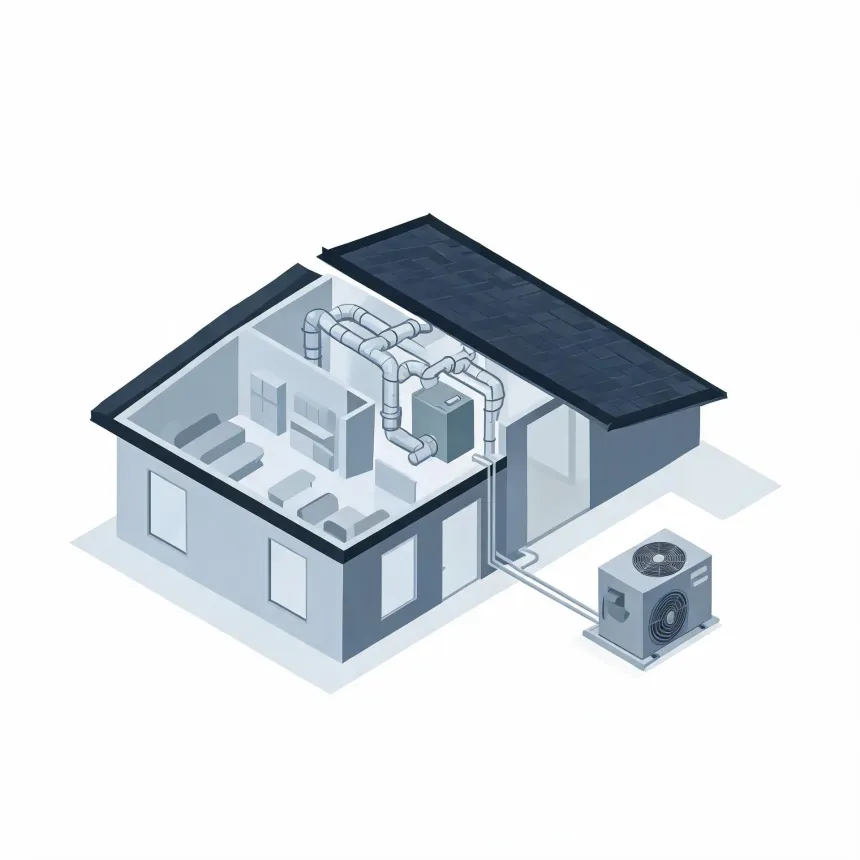
Find a contractorHalf the homes in this county were built in 1965 or earlier. A heat pump going into a house that age isn't going into a shell built for it. Before it goes in, someone needs to check what's already there: the ductwork, the electrical panel, the spot where the old system sat. A system sized off the house on paper, instead of the one actually standing there, ends up working against it every day it runs.
A heat pump has to be sized to the house, not picked off a chart by square footage. That means a load calculation that looks at insulation, window area, ceiling height and duct layout before anyone quotes a price. Skipping that step is how a contractor ends up installing a bigger unit than the house needs, and a bigger unit costs more up front, costs more to run, and cycles on and off instead of holding steady.
Installation price isn't just the equipment. If the ductwork is undersized or leaky, it may need sealing or rework before the new system can move air the way it's rated to. If the electrical panel can't carry the new unit's load, that's its own job before the heat pump goes in. A straightforward swap onto existing ductwork and wiring costs less than a job where those have to be brought up to what the new system needs.
A load calculation is what decides the size, not a guess based on the old unit or the square footage on a listing. It works through the walls, the windows, the insulation, the ceiling height and the duct layout to find out how much heat the house actually loses in winter and gains in summer. That number, not a rule of thumb, is what the new heat pump gets sized against. Go too big and the unit short cycles, reaching the thermostat setting fast and shutting off before it's pulled enough moisture out of the air or run long enough to settle into steady, efficient operation. Go too small and it runs constantly on the coldest and hottest days, never quite catching up. Either mistake shows up as uneven temperatures room to room and a system that wears out its parts faster than one sized right from the start.
Install day starts with the outdoor unit and the indoor coil, and the two have to be matched, not just connected. The line set gets run between them, pressure tested, then pulled down into a vacuum to clear out air and moisture before any refrigerant goes in. Skipping that vacuum step is how moisture ends up sealed inside the lines, and moisture in a sealed refrigerant system causes corrosion down the road that no amount of good maintenance fixes later. Once the lines check out, the system gets charged to the exact weight the manufacturer specifies, not by feel. Then it gets run through its paces: heating mode, cooling mode, defrost cycle, checking that the thermostat is actually talking to the unit the way it should. A heat pump that looks installed but was never charged and tested properly will run, for a while, before the shortcuts show up as a breakdown.