Seven months of work
A furnace in Granite City runs October through April. That's seven months of cycling on and off, enough for an igniter or blower motor to wear out on its own schedule, regardless of what winter does this year.
Takes about a minute. No obligation.
A furnace in Granite City runs October through April. That's seven months of cycling on and off, enough for an igniter or blower motor to wear out on its own schedule, regardless of what winter does this year.
Overnight lows here average 25°F in December, January and February. That's normal work for a furnace built to heat a Midwest home. A breakdown is more likely a worn part reaching the end of its life than anything the cold is doing to it.
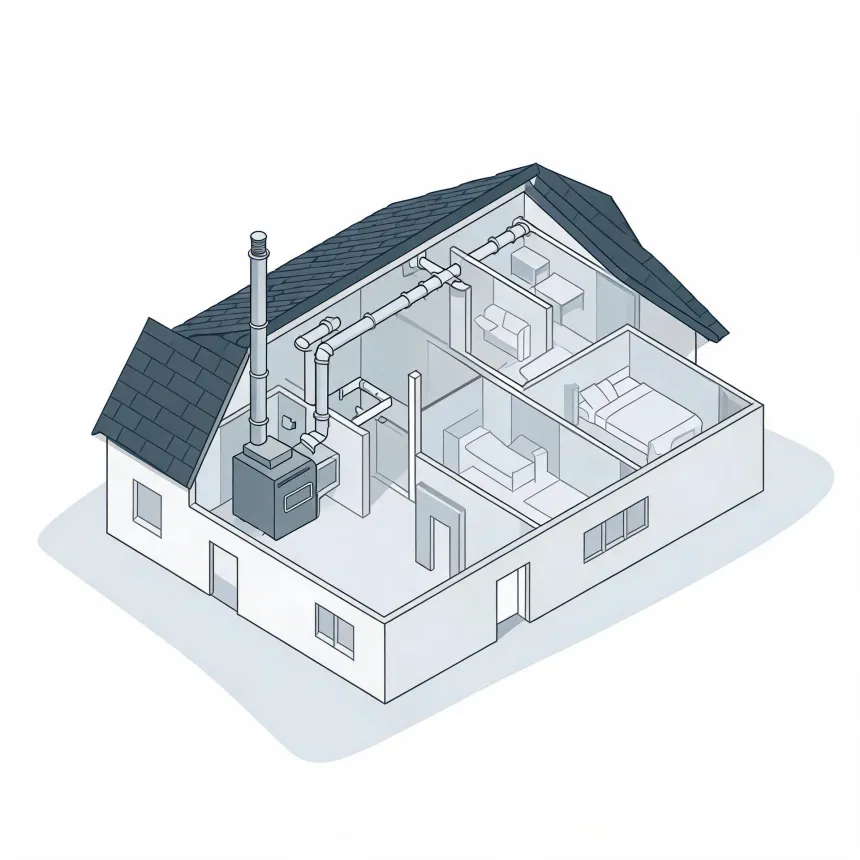
NOAA nClimDiv, 1991–2020 normals
September is the last quiet month before a Granite City furnace starts up for the season.
The first cold weeks of October put a full load on a furnace, and that's when a part that was already weak tends to give out.



Half the homes in Madison County were built in 1971 or earlier. If yours is one of them, the furnace inside it has very likely been replaced at least once already, maybe more than once, and whatever is running now has its own age separate from the house. A furnace generally lasts a couple of decades with regular care. If nobody can tell you when it was put in, or if it's the original unit, it's worth asking a contractor how much life is left in it before you put money into fixing what just broke.
A repair call is a good time to ask the contractor how old the furnace actually is and how much life is left in it. If it's getting up there, that's worth knowing before you spend money on the part that just failed.
Find a contractor
Before anyone comes out, check a few things that are safe to check. Look at the thermostat first. Make sure it's set to heat, not cool, and that the set temperature is actually above room temperature. Check the batteries if it's a battery model, since a dead thermostat display can look like a dead furnace. Next, find the furnace's power switch, it looks like a regular light switch, usually mounted on or near the unit, and make sure nobody bumped it off. Check the breaker too. Then look at the air filter. A filter so clogged that air can't move through it will make a furnace shut itself down as a safety measure, and that's something you can see just by pulling it out and holding it up to a light. If you can't see light through it, that's likely part of the problem. Last, check that the vent hood outside and any intake or exhaust pipes aren't blocked by debris. None of this fixes an igniter or a failed blower motor, but it rules out the simple stuff before you pay someone to find the same thing.
A heat exchanger that's starting to crack still runs. It heats the air, the furnace seems fine, but each time it fires the metal flexes with the heat and the crack grows a little more. Left alone long enough, it stops being a repair and becomes a reason to shut the furnace off entirely.
When a blower motor is struggling, the furnace often keeps firing anyway. Heat builds up in the cabinet with nowhere to go, and that extra heat is hard on the igniter, the limit switch and the control board. A motor that would have been a straightforward swap can end up costing more by the time it finally quits.
Estimates for a typical Madison County home, compared with an older unit built to the previous federal minimum, from EIA household energy data, Illinois fuel prices and NOAA climate normals. Your home will differ.
Repair makes sense when one part has failed and the heat exchanger is sound.
Replacement makes sense when the heat exchanger is cracked or the furnace keeps needing parts.
A repair is worth doing when the furnace is otherwise sound and the failed part is an isolated thing, a single component that wore out on its own. A cracked heat exchanger is a different kind of decision, because that's the one failure that isn't safe to work around, and a contractor who finds one is going to recommend replacement regardless of how the rest of the unit looks. An older furnace that needs repeat repairs within the same season is telling you something a single repair bill won't show. The part that just failed might be a quick fix, but if another part is close behind it, you end up paying for the same furnace more than once. Ask the contractor what else on the unit is showing its age before you decide, not just what broke this time.