




A nighttime street view of several illuminated two-story red brick homes with front porches, flanked by a large tree.

Heat Pump Installation in Decatur, IL

Tell us about the job

Takes about a minute. No obligation.

Step 1 of 3: Equipment

Electricity in Macon County runs 18.18 cents per kilowatt-hour, more than most US counties pay. A heat pump runs on electricity for both heating and cooling, so that rate touches the bill every month of the year, not just in summer. Two heat pumps can heat and cool the same house, and the less efficient one shows it on every bill. Summer adds its own load here. The dew point around Decatur averages 65°F across June, July and August, heavy enough that the system is pulling moisture out of the air along with cooling it. A unit sized and rated for that load runs the way it's supposed to instead of working harder than it should through the muggy months.

7 months
October through April, your system heats
4 months
June through September, it cools
22°F
the average winter night it heats against
84°F
the average summer afternoon it cools against
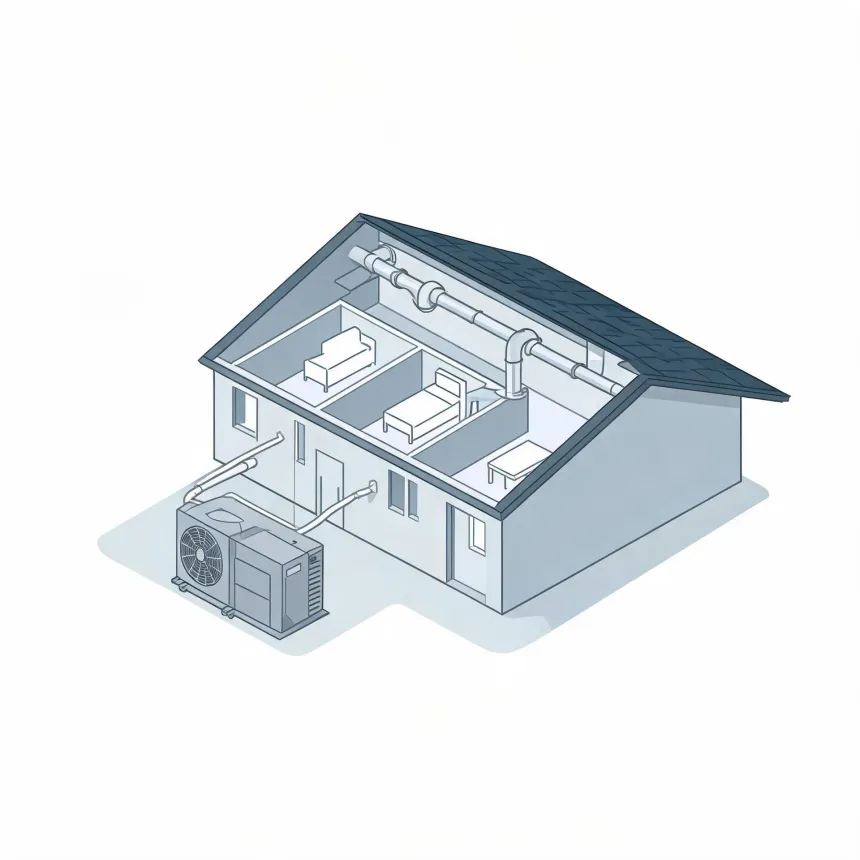
Isometric line illustration of a cutaway single-story house showing interior rooms with furniture and attic ductwork connected to an outdoor condenser unit beside the building.
Your system heats October through April and cools June through September.

NOAA nClimDiv, 1991–2020 normals

Gas heats 73.5% of homes in Macon County.

A heat pump paired with that furnace handles summer while the furnace keeps doing winter the way it already does.

Half these homes went up before central air was standard

Half the homes here were built by 1964
109 damaging wind events from 2015 to 2024
47 hail events from 2015 to 2024
Best installed before heat or cooling season startsHomes here run cooling June through September and heat October through April, so May and September are the months to get ahead of it.

Macon County sits in climate zone 5A, a zone the federal code treats as cold enough that heating matters more than cooling over the year. Any split-system heat pump installed here now has to clear federal minimums set for that kind of load: at least 14.3 Btu of cooling delivered for every watt-hour it uses, and at least 7.5 Btu of heating for every watt-hour in winter. Those numbers aren't a ceiling. They're the floor every new unit has to clear before it goes in a home here. A contractor sizing a system for this county is already working within that standard, not deciding whether to meet it. Federal tax credits are available for systems that qualify, on top of what the efficiency itself does for the bill.

At this electric rate, efficiency pays you back year round

That electric rate applies to every month a heat pump runs, not just the muggy ones. An efficient unit draws less power to deliver the same heating and cooling, and at this rate the difference shows up on every bill, all year. Getting the sizing and the equipment right at installation is what makes that difference work for you instead of against you.

Find a contractor
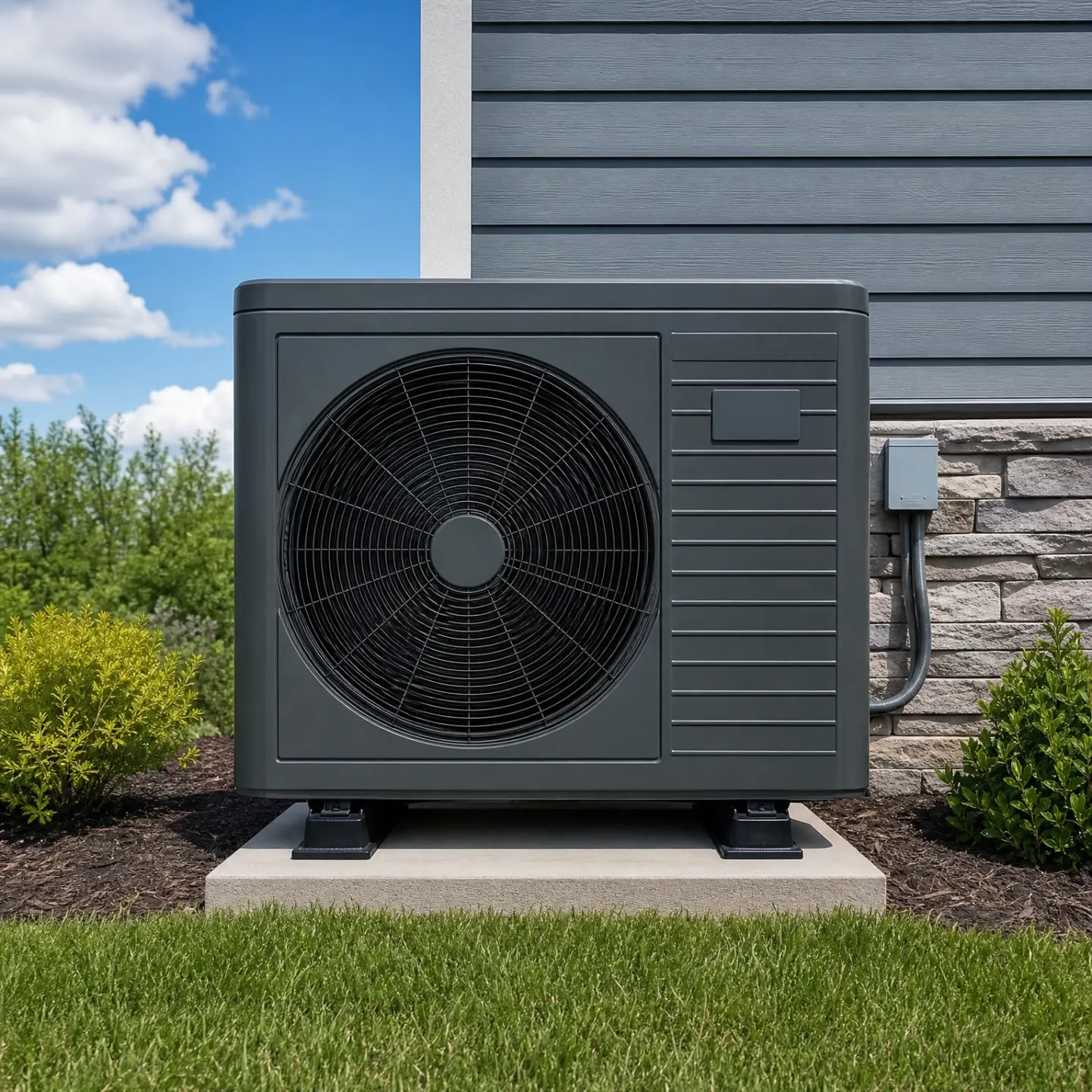
A dark gray heat pump unit mounted on a concrete pad next to a house with gray siding and a stone veneer wall.

What to ask when you're comparing two systems

Every heat pump on the market has to clear the same federal efficiency floor, so comparing two systems means looking past that number to what else is on the spec sheet. Ask what the unit sounds like running, since sound ratings vary by model and a compressor humming outside a bedroom window matters over the long run. Ask what refrigerant it uses, since older refrigerants are being phased out and parts availability follows that. Ask how the manufacturer's warranty is structured, because some cover parts only while others cover labor too, and that changes what a future repair actually costs. Ask whether the compressor is a single stage, two stage, or variable speed unit, since a variable speed compressor adjusts its output to match the load instead of running full blast or not at all, which affects comfort and how evenly the house heats and cools. Ask what backup heat source pairs with it and how the two are set to work together, since a heat pump that fights its backup heat instead of handing off to it smoothly ends up costing more to run than it should.

A bigger unit isn't a safer bet

An oversized heat pump cools the air fast and shuts off before it pulls the moisture out of it, so the house ends up cold and damp. In heating mode it short cycles the same way, kicking on, hitting the thermostat setting, and shutting off again before it runs long enough to heat evenly. Short cycling also wears the compressor harder, since the start is where it draws the most and stresses the most.
Sizing comes from a load calculation, not the old system

A contractor works out the right size with a room by room load calculation, called a Manual J, that accounts for square footage, window area, insulation, ceiling height, and how the rooms are laid out. Matching the new heat pump to whatever system is already there just carries forward someone else's guess, or a size that was right for a different setup entirely. The ductwork gets checked too, since a heat pump moves air differently than what it's replacing, and the ducts have to move the right amount for the unit going in.

What drives the cost of putting in a heat pump comes down to how much equipment and labor the job actually needs. A straight swap, same ductwork, same electrical, same spot outside, is the simplest version. It gets more involved from there. If the home needs a larger electrical circuit to run the new unit, that's additional wiring and panel work. If the ductwork is undersized or leaky, sealing or modifying it adds to the job before the heat pump ever gets mounted. The outdoor unit needs a clear, level pad and enough clearance around it to pull air through the coil, so site prep varies house to house. Line sets run between the outdoor unit and the indoor coil, and the length and routing of that line affects labor time. A backup heat source, where one is used alongside the heat pump, adds its own wiring and controls. None of this is optional dressing. Each piece is part of getting a heat pump to run the way it's rated to run, and skipping any of it to save on the install is what shows up later as a unit that struggles or wears out early.

Install day starts with the outdoor unit and the indoor coil, and most of the work happens before either one is set in place. The old equipment comes out first, lines are recovered, and the contractor checks the electrical and the ductwork against what the new system needs rather than assuming they'll just connect. Line sets get run or reused between the outdoor unit and the indoor coil, then the system is evacuated to pull moisture and air out of those lines before refrigerant goes in. A heat pump that gets charged with air still in the lines will run poorly from day one, so that step isn't skipped. Once it's charged, the contractor runs it in both heating and cooling, checks the temperature split at the vents, and sets the thermostat and any backup heat to work together instead of fighting each other. The last part is explaining what the new controls do, since a heat pump thermostat often behaves differently than what it replaced.