Three illuminated two-story brick houses on a tree-lined residential street photographed at twilight, with warm window light and landscape uplighting visible against a deep blue evening sky.

Heat Pump Installation in Carbondale, IL

Tell us about the job

Takes about a minute. No obligation.

Step 1 of 3: Equipment

Electricity here runs 17.50 cents a kilowatt-hour

That is higher than what most US counties pay. A heat pump here draws on that same expensive power for both heating and cooling, so every kilowatt it uses shows up on the bill at a steeper rate than most homeowners deal with.

Efficiency decides what you pay every month

With power this costly, the difference between a heat pump that runs efficiently and one that does not stops being a small detail. It is the main thing that decides what this system costs you to live with, month after month.

7 months
October through April, your system heats
5 months
May through September, it cools
27°F
the average winter night it heats against
87°F
the average summer afternoon it cools against
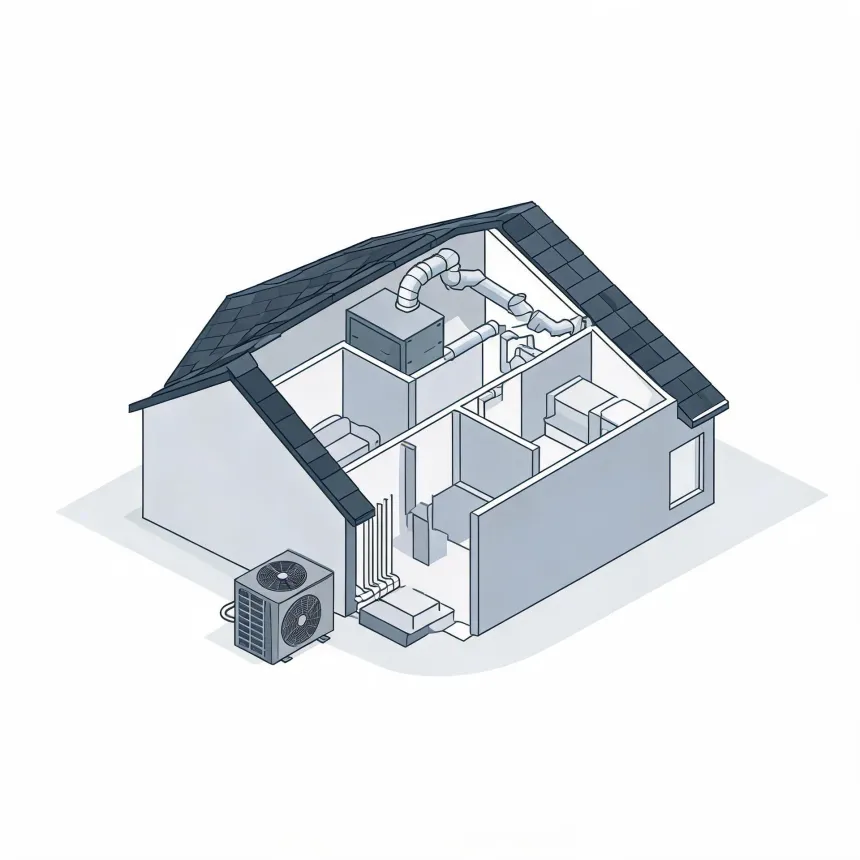
Isometric line illustration of a cutaway house showing interior rooms, an air handler with ductwork in the attic space, and an outdoor condenser unit beside the exterior wall.
Your system heats October through April and cools May through September.

NOAA nClimDiv, 1991–2020 normals

Heat pumps here run heat from October through April, about seven months straight.

Get a new system in before October and it's sized and set up before it has to carry the house through winter.

Electricity already heats most homes in Jackson County, so a heat pump replaces what's already there

57.5% of homes heat with electricity
130 damaging wind events from 2015 to 2024
30 hail events from 2015 to 2024

Jackson County falls under climate zone 4A, a mixed zone where both heating and cooling put in real work over the year. Any split-system heat pump installed here has to meet the federal minimum for that use: at least 14.3 Btu of cooling for every watt-hour of power it draws, and at least 7.5 Btu of heating for every watt-hour in winter. Those numbers set the floor, not the ceiling. A system can be built to clear them by a wide margin, and in a county paying this much per kilowatt-hour, that margin is what shows up as a lower bill. A federal tax credit is available on qualifying heat pumps, which helps offset the cost of choosing one that runs well above the minimum.

Pick the efficiency, not just the system

The minimum rating gets a permit signed off. It does not get you the lowest bill. Power here costs more than most places pay, and a heat pump built past the federal minimum is what turns that into a lower bill instead of a higher one, every month it runs.

Find a contractor
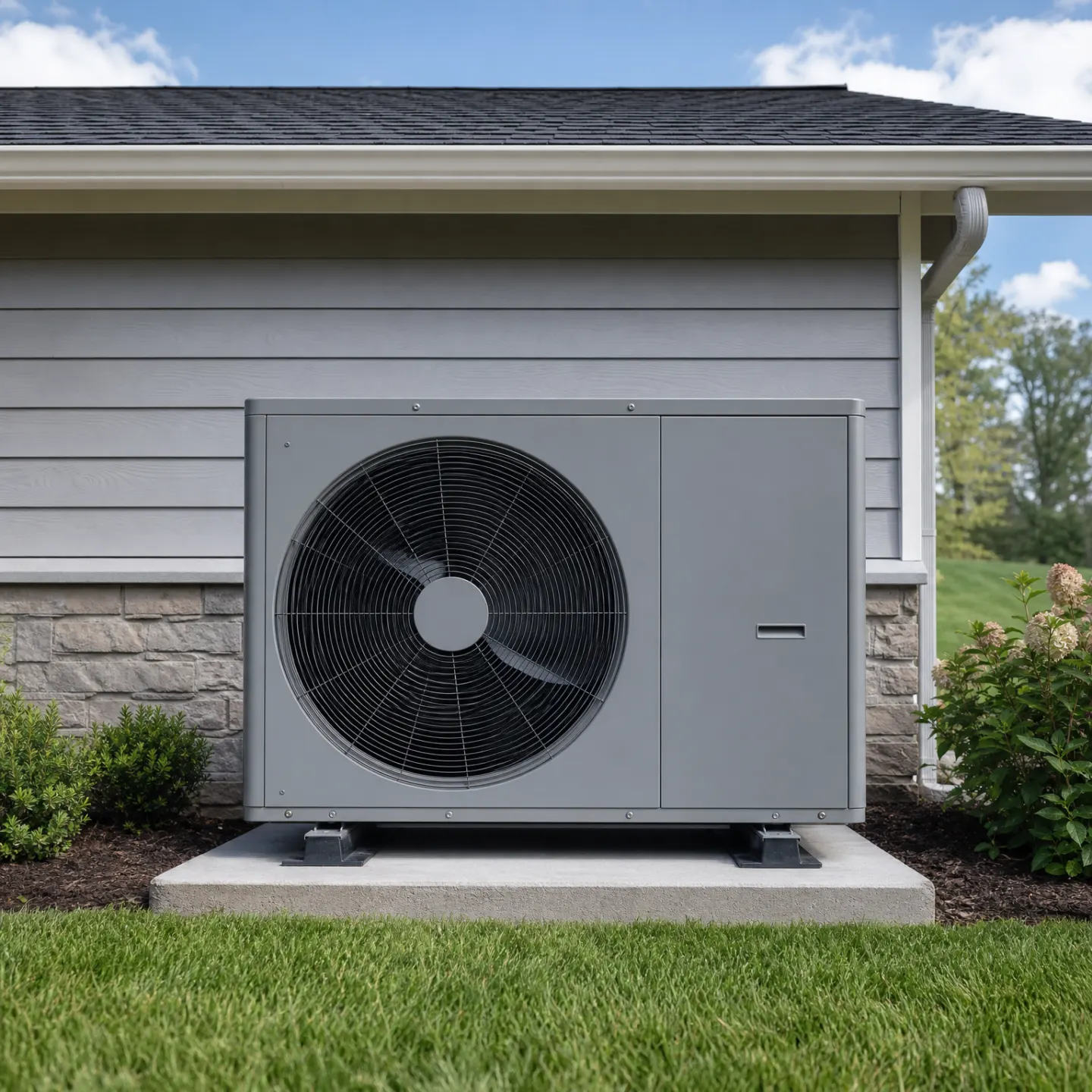
A gray outdoor HVAC unit mounted on a concrete pad beside a house with gray lap siding and a stone foundation.

Ask how the compressor is built to run, not just how big it is

When you compare systems, ask how the compressor is built to run. A heat pump does not fire up to catch the house up and then shut off the way a furnace burner does. It cycles on and off through the day to hold temperature steady, so it sees far more total running hours over a year. A single-speed compressor runs at full output every time it kicks on, which means more starts and stops and bigger swings in temperature between them. A variable-speed or multi-stage compressor adjusts its output to match what the house needs at that moment, so it runs longer at a lower level instead of slamming on and off. Ask what stage of compressor each system actually uses, not just what the brochure calls it. Also ask about the defrost cycle. Every heat pump has to reverse and melt frost off the outdoor coil in cold weather. A unit on a fixed timer runs that cycle whether the coil needs it or not. One with a smarter control checks the coil and defrosts only when frost has actually built up, which means less wasted run time over the months it works hardest.

The install decides the ceiling on efficiency

A heat pump only hits its rated numbers if the refrigerant charge is correct and the airflow across both coils matches what that system needs. Too little charge and the compressor works harder for less heating and cooling. Ductwork that is too small or too restrictive holds back airflow no matter how good the unit is. None of that shows up on a spec sheet. It shows up in how the system actually runs once it is in.

Sizing wrong costs you twice

A unit sized too big for the house cools or heats the air quickly, then shuts off before it has pulled the moisture out or settled the temperature evenly, so it cycles on and off more than it should. One sized too small runs constantly and still struggles to keep up on the hardest days. Either way the compressor is working outside the range it was built to run in most efficiently. Getting the size right starts with a load calculation on the house itself, not a guess based on the old equipment it is replacing.

The rating on the label is a ratio, not a fixed amount of comfort. It tells you how much heating or cooling the system produces for each unit of power it draws, measured in a lab under set conditions. A higher number means the compressor is getting more work out of the same electricity, not that it works harder or runs stronger. Two systems can heat the same house to the same temperature, and the one with the better rating does it while pulling less power to get there. That rating only holds if the system is matched correctly and installed to spec. Treat the number on the label as what the equipment is capable of, not what it will deliver on its own.

Installation day starts before anyone touches the old equipment. A tech runs a load calculation on the house if one hasn't been done, checks the ductwork for leaks or restrictions, and confirms where the new outdoor unit and indoor coil will sit. Pulling the old system out usually comes first, then setting the new air handler or coil, running the refrigerant lines, and mounting the outdoor unit on a level pad with clearance on all sides. Once everything is connected, the line set gets pressure tested for leaks before any refrigerant goes in. Charging the system to the right level comes next, checked against the manufacturer's specification for the line length and conditions that day, not just topped off and left. Airflow gets checked at the vents, the thermostat gets wired and set up, and the system runs through a cycle in both heating and cooling before the crew leaves. None of those steps are optional if the system is supposed to hit the numbers on its label.