A row of dark gray single-story houses with asphalt shingle roofs behind trimmed hedges and a mown lawn, framed by overhanging tree branches under an overcast sky.

Heat Pump Repair in Waukegan, IL

Tell us about the job

Takes about a minute. No obligation.

Step 1 of 3: Equipment

Warm air in winter mode means trouble

A heat pump in heating mode should blow air that feels warm at the vent. If it's blowing cool or barely lukewarm air, the reversing valve may be stuck or the refrigerant charge may be low. Either way the system isn't moving heat the way it should, and running it like that for long can put more strain on the compressor.

Ice that won't clear points to a real problem

Heat pumps frost up during normal defrost cycles, and that's nothing to worry about. What matters is whether the ice goes away on its own. If the outdoor unit stays coated or keeps building up, the defrost control board, a sensor, or the reversing valve likely isn't doing its job, and that's a repair call, not something to wait out.

8 months
October through May, your system heats
3 months
June through August, it cools
19°F
the average winter night it heats against
81°F
the average summer afternoon it cools against
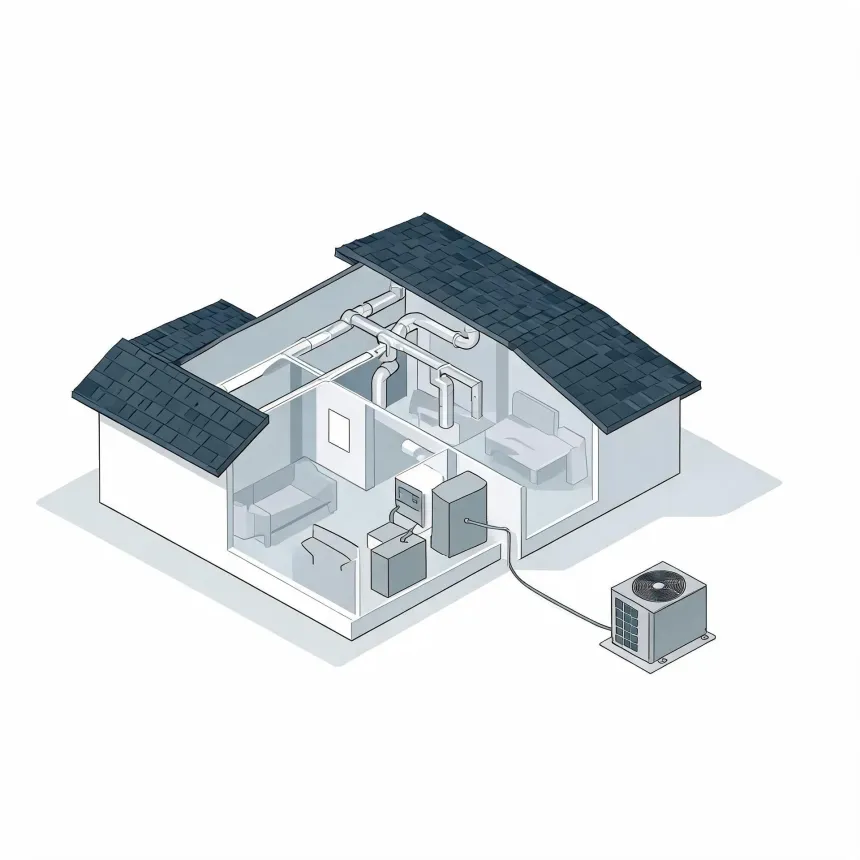
Isometric cutaway illustration of a single-story house showing interior ductwork, an indoor air handler and furnace unit, and an outdoor condenser connected by a line, on a white background.
Your system heats October through May and cools June through August.

NOAA nClimDiv, 1991–2020 normals

A heat pump that's old enough to need its second or third compressor isn't worth saving.

But a cracked contactor or a failed capacitor can take down a unit that's otherwise got years left in it.

A heat pump that's struggling to keep up runs longer and costs more at 15.87 cents a kWh

Power costs 15.87 cents a kWh statewide
138 damaging wind events from 2015 to 2024
64 hail events from 2015 to 2024

Lake County gets hit with its share of wind and hail, 138 damaging wind events and 64 hail events logged over the past decade. None of that points to your heat pump specifically. Wind can loosen a panel or throw debris into the outdoor unit, and hail can dent a cabinet or bend fins, but a contractor checks for that in minutes just by looking. A power outage during a storm is more likely to be behind a system that suddenly won't start at all, since a hard stop can trip a safety switch that needs to be reset by hand. Outside of that, whatever is wrong with your heat pump right now is almost certainly the same thing that goes wrong with heat pumps anywhere. A part failed, or a control stopped doing its job.

Half the homes here were built in 1983 or later

Half the homes in Lake County were built in 1983 or later. If yours is one of them, the heat pump likely isn't old either, and a system with years left in it is usually worth repairing rather than replacing.

Find a contractor
A man in a cap, long-sleeve shirt and work pants climbs porch steps toward a dark blue front door, carrying a worn canvas tool bag, with a small potted evergreen beside the entry.
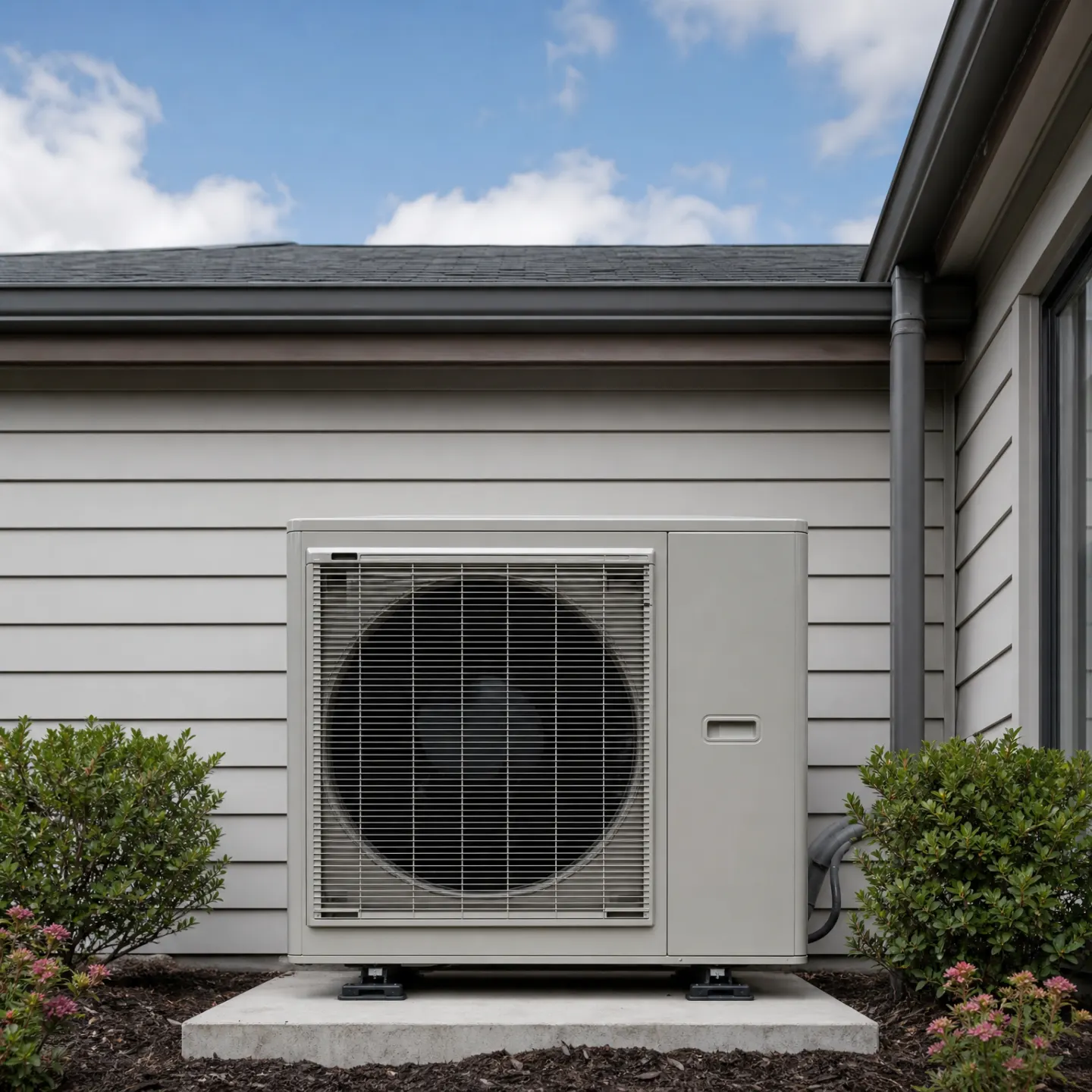
A gray heat pump condenser unit mounted on a concrete pad against the gray lap-siding exterior wall of a house.

A newer system is worth fixing

A heat pump installed with a newer build hasn't put in the years that push a compressor toward its second or third failure. That's the range worth repairing in. If yours stopped working, get a contractor to look at it before you assume the worst about its age.

The capacitor and contactor wear out first

The run capacitor gives the compressor and fan motor the jolt they need to start, and it weakens with every cycle until one day it can't anymore. The contactor is the switch that sends power to the outdoor unit, and its contacts pit and burn from years of making and breaking that connection. Both are common failures, both are inexpensive parts, and neither means anything is wrong with the compressor itself.

A low charge points to a leak, not just lost refrigerant

A heat pump is sealed. It doesn't use up refrigerant or need it topped off like oil in a car. If the charge is low, refrigerant is escaping somewhere, usually at a joint, a coil, or a fitting that's worked loose. Adding refrigerant without finding the leak just means doing it again in a few months, so the leak has to be found and sealed first.

A heat pump that's low on charge or stuck in the wrong mode still runs when you flip the thermostat, and that's what makes it easy to put off. But the compressor is built to move refrigerant at a certain pressure, and when the charge is wrong or the reversing valve won't seat, it's working outside that range every minute it runs. The extra heat that generates has nowhere to go. Keep that up long enough and a bad capacitor or a stuck valve stops being the problem. A compressor that's taken that kind of strain for too long can fail on its own, and that one doesn't get repaired. It gets replaced.

A diagnostic starts at the thermostat and works outward. A contractor checks what mode the system is set to, what it's calling for, and whether the outdoor unit actually responds to that call. Gauges go on the refrigerant lines. A meter checks the capacitor and the contactor. If ice was part of the complaint, the defrost board and its sensors get tested too. Airflow gets checked as well, since a coil starved for air can look like a refrigerant problem even when it isn't one. Most of this takes minutes once the panels are off. What it turns up decides what happens next. A part gets swapped, a leak gets traced, or the compressor itself gets tested, and that last finding is the one that turns a repair call into a replacement conversation.