Electricity here runs 17.71 cents a kilowatt-hour
That is higher than what most US counties pay, and a heat pump runs on electricity. A unit that does not hold its efficiency over time will show it on every bill, not just the first one.

Takes about a minute. No obligation.
That is higher than what most US counties pay, and a heat pump runs on electricity. A unit that does not hold its efficiency over time will show it on every bill, not just the first one.
A heat pump installed to match your home's heat loss earns its efficiency rating. One that is oversized, undersized, or set up wrong burns more power to do the same job, and at Knox County rates that difference is bigger than it would be somewhere cheaper.
NOAA nClimDiv, 1991–2020 normals
Half the homes in Knox County were built in 1957 or earlier.
A heat pump has to be sized for the house it's going into, not for a average one.




Knox County falls under zone 5A in the 2021 energy code, a cool zone where heating is the bigger job for the system. Any split-system heat pump installed since January 2023 has to meet federal minimums to be sold at all, 14.3 for cooling and 7.5 for heating. Those numbers set the floor. Contractors here aren't choosing between efficient and inefficient units, they're choosing what to put in above that floor, and how well it's sized and set up once it's in.
The rate here already makes the case for getting the sizing right. A contractor can run a load calculation on your house and size the unit to match it, instead of guessing from a chart. That's the step that decides what you pay to run this thing from here on.
Find a contractor
A load calculation on an older home is going to turn up things a square footage chart never catches. Where the insulation is thin, where a room runs cold, where the ductwork was patched or extended over the years. If your home came with the house, a contractor working from its actual heat loss can size the heat pump to match, not to a number pulled from a newer build down the road. Get that sizing right at install and it stays right for as long as the unit runs.
The label carries two ratings, one for cooling and one for heat. A heat pump earns its keep on the heating side as much as the cooling side, since it's running both jobs on the same refrigerant loop and the same compressor. A unit with a strong cooling rating and a weak heating one will still cost you on the months it's pulling heat from outside air instead of dumping it.
That number on the label comes from lab testing with the charge, airflow and ductwork all correct. Low refrigerant charge, a duct that's too restrictive, or airflow that doesn't match the coil and the unit stops hitting the number on its own label. The rating tells you what the equipment is capable of. Whether it gets there depends on how it's installed.
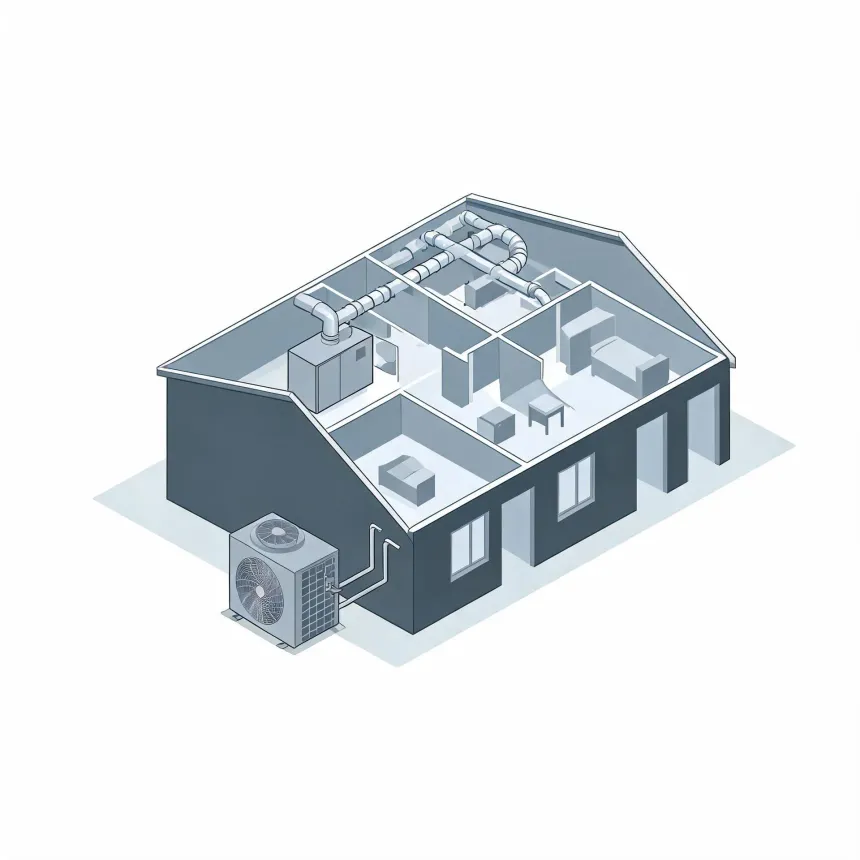
Sizing a heat pump starts with a load calculation, not a chart that goes by square footage. A contractor measures how much heat your house loses in winter and gains in summer, room by room, factoring in windows, insulation, and how the ductwork runs. That number tells them what size compressor the job actually needs. Go bigger than that and the unit short cycles, reaching the temperature on the thermostat and shutting off before it's pulled enough moisture out of the air or run long enough to move heat efficiently. Go smaller and it runs flat out on the coldest and hottest days and still can't keep up, so it leans on backup heat strips more than it should. Either mistake shows up as a system that runs more than it needs to just to hold the house at temperature.
Install day starts before anyone touches the old equipment. A contractor runs the numbers again to confirm the unit on the truck matches what the load calculation called for, then walks the house to see where the line set will run and where the new unit will sit. Setting the outdoor unit is a different job than setting the indoor coil, and both have to be level and clear of anything that blocks airflow. Once the lines are connected, the system gets evacuated to pull out moisture and air before any refrigerant goes in, and it's charged to the exact weight the manufacturer specs, not by feel. The electrical hookup has to match what the compressor draws, including the breaker and the disconnect outside. Before anyone leaves, the system should run through a full cycle, heating and cooling both, with the airflow and the charge checked against what the equipment is rated for. A heat pump that skips any of those checks on install day can still turn on and blow air. Whether it runs the way the label says is a separate question, and it gets answered that day or not at all.