Electricity here runs 15.87 cents a kilowatt-hour
Illinois homes paid that rate in 2024. A heat pump runs on electricity for both heat and cooling, so that rate applies every time it cycles on, winter and summer.
Takes about a minute. No obligation.
Illinois homes paid that rate in 2024. A heat pump runs on electricity for both heat and cooling, so that rate applies every time it cycles on, winter and summer.
Two heat pumps can cost the same to install and run very differently once the power bill comes. At this rate, the difference between a mid-grade unit and a high-efficiency one shows up every month, not just in a sales pitch.
NOAA nClimDiv, 1991–2020 normals
A heat pump sized too big for the house short-cycles, running a few minutes at a time and shutting off before it pulls the moisture out of the air.
The right size comes from a load calculation on the house itself, the windows, the insulation, the square footage, not a guess based on the old system.



Woodford County sits in climate zone 5A, a cool zone where winter heat is the bigger job and summer humidity still has to be dealt with. Any split-system heat pump installed here has to meet the federal minimum set for that zone. Cooling efficiency has to reach 14.3 SEER2, and heating has to reach 7.5 HSPF2. That floor applies to units built from 2023 on, so it already rules out the older, lower-rated equipment some price quotes are still built around. A contractor can install above that minimum. They cannot install below it.
Gas heats most homes in Woodford County, 65.6 percent of them. If that's what you have now, a heat pump is an added system, not a swap, and it's worth asking a contractor to lay out what pairing the two looks like versus going all-electric.
Find a contractorHalf the homes in Woodford County were built in 1972 or earlier. A heat pump going into a house that old is going into walls, ducts and windows nobody designed around a heat pump. The load calculation has to use what the house is now, not what a furnace from decades back was sized for. If ductwork was built for a gas furnace running hot air in short bursts, a heat pump moving cooler air for longer stretches may need some of it resized or sealed before it can hold the house at temperature.
The unit itself is only part of what you're paying for. Labor to set the refrigerant lines, an electrical circuit sized for the compressor, a pad or mount, and a thermostat that can actually run a heat pump instead of a furnace all add to the job. Homeowners buying the same model can end up with different bills once the rest of the install is accounted for.
If the ductwork, electrical panel and refrigerant lines already suit a heat pump, the install is mostly swapping equipment. If the panel needs more capacity, the lines are the wrong size, or the ducts need sealing or resizing, that work happens before the heat pump ever turns on. None of it shows up in the price of the unit alone.
If the old system is a furnace, most of it comes out. The furnace itself, the coil above it, usually the thermostat too, since a heat pump needs one built to run it instead. Whoever handles the install should also check the venting and gas line that served the furnace, since those get capped off or removed rather than left live and unused. A central air condenser is a different case. Some of its parts, the line set or even the air handler, may carry over if they're rated for it, so it's worth asking what actually needs replacing versus what already works. Whatever comes out has refrigerant or combustion history tied to it, so it's not something to leave sitting in the yard or haul off without the contractor signing off on how it's handled.
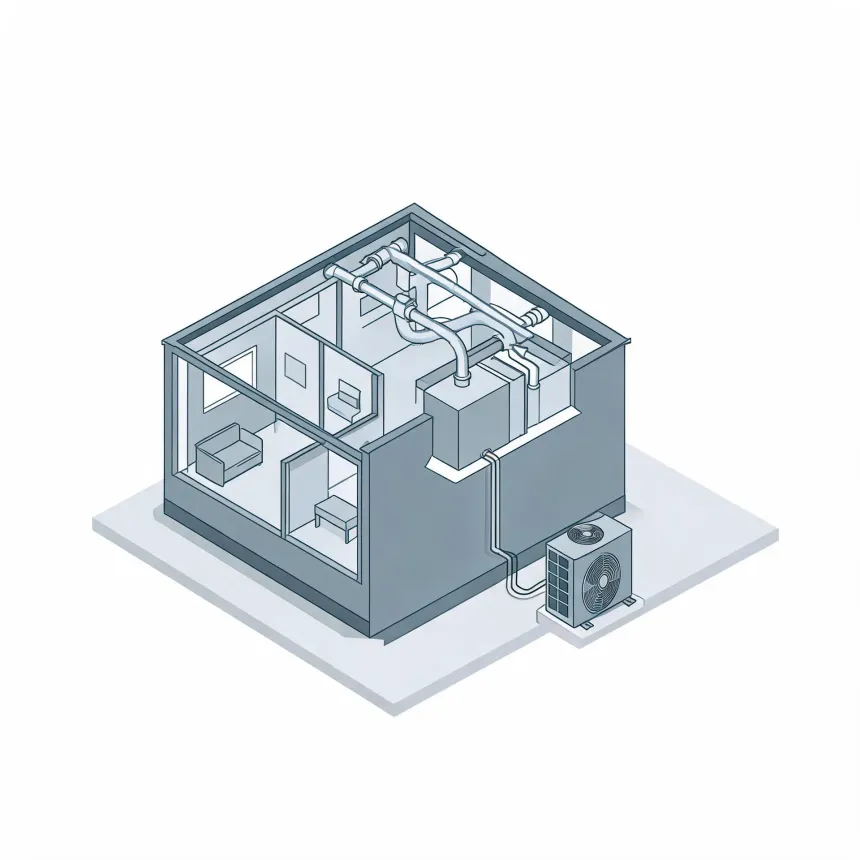
Install day starts outside, with the outdoor unit set on its pad and the line set run between it and the indoor coil. Those lines get connected, then pulled down to a vacuum to clear out air and moisture before any refrigerant goes in, because either one left in the system will wreck the compressor over time. Inside, the air handler or coil ties into the ductwork, and the electrical circuit for the compressor gets run and checked against what the breaker panel can carry. Once everything's connected, the system gets charged with refrigerant to the weight the manufacturer specifies, not just topped off by feel. Then it runs through a cycle while the contractor checks airflow at the vents, the temperature split between the air going in and the air coming out, and that the thermostat is actually talking to the heat pump correctly. A system that looks installed and a system that's been checked out running are not the same thing.