A dark horizontal-sided building corner in the left foreground beside a mowed lawn, with a light-colored single-story house and large deciduous trees under a pale sky in the background.

Heat Pump Repair in DeKalb, IL

Tell us about the job

Takes about a minute. No obligation.

Step 1 of 3: Equipment

The first cold week in October is when problems show up

A heat pump that was already weak tends to hold on fine through mild weather. Once DeKalb County hits its first real cold mornings in October, the system has to work harder, and that is when a low charge or a worn part finally gives out.

September is the month to catch it early

Heat runs October through May here, so September is the last stretch before the heat pump has to carry the full load. A problem found now gets fixed before the cold sets in, instead of in the middle of the first freeze.

8 months
October through May, your system heats
3 months
June through August, it cools
17°F
the average winter night it heats against
82°F
the average summer afternoon it cools against
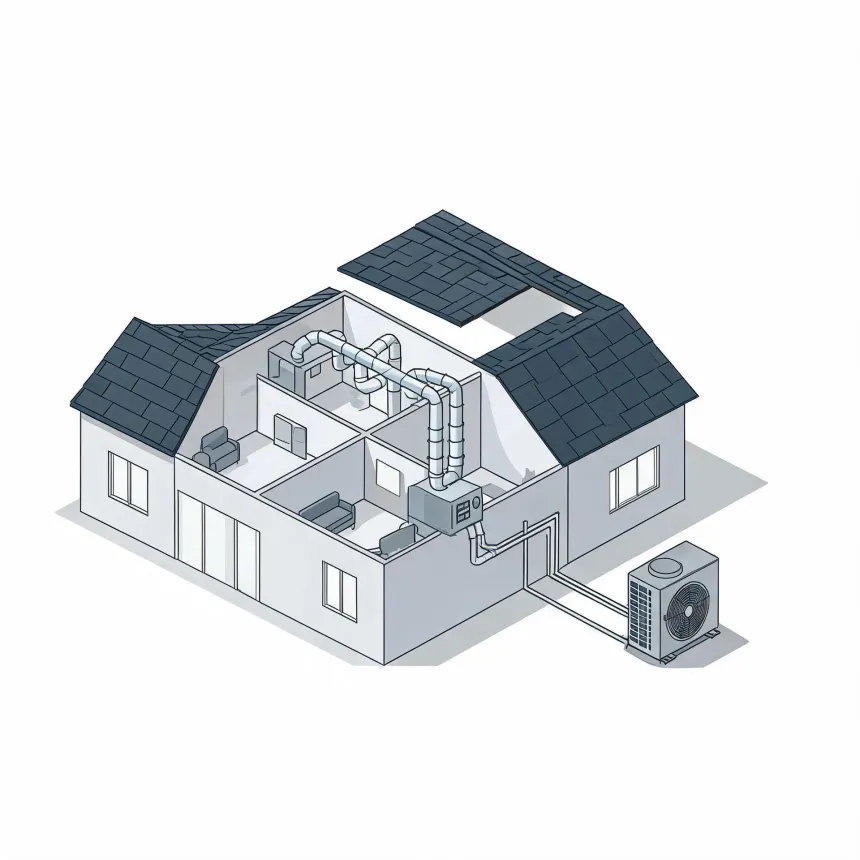
Isometric line illustration of a cutaway single-story house showing interior rooms, ceiling ductwork connected to an indoor air handler, and refrigerant lines running to an outdoor condenser unit on a pad.
Your system heats October through May and cools June through August.

NOAA nClimDiv, 1991–2020 normals

Winter here settles into the teens overnight, the normal range for a heat pump to work against.

A heat pump sized and maintained for DeKalb County handles that fine, so a breakdown points to a specific part, not the weather.

At 15.87 cents a kilowatt-hour, a heat pump running wrong runs up your bill every day it's not fixed

Power costs 15.87 cents a kWh statewide
105 damaging wind events from 2015 to 2024
27 hail events from 2015 to 2024
Old house or new, the fix is the sameHalf the homes in DeKalb County were built in 1978 or earlier, half in 1978 or later.

A tech starts outside at the outdoor unit, checking the refrigerant charge and the compressor before anything gets taken apart. Low charge shows up as ice on the coil or weak heat at the vents, and it points to a leak somewhere in the line. Next comes the reversing valve, the part that switches the system between heat and cooling. A stuck reversing valve is one of the more common reasons a heat pump blows cold air when it should be blowing warm. Inside, the tech checks the air handler, the blower motor, and the thermostat signal, making sure the system is actually being told to heat and is responding. If the outdoor fan isn't turning or the coil is iced over despite a working defrost cycle, that narrows things down fast. By the end of the visit you should know which part failed and why, not just that something did.

A heat pump running wrong costs you every day it waits

Get the actual part diagnosed now rather than later. A stuck reversing valve or a low charge does not get cheaper to run while it sits, not at 15.87 cents a kilowatt-hour.

Find a contractor
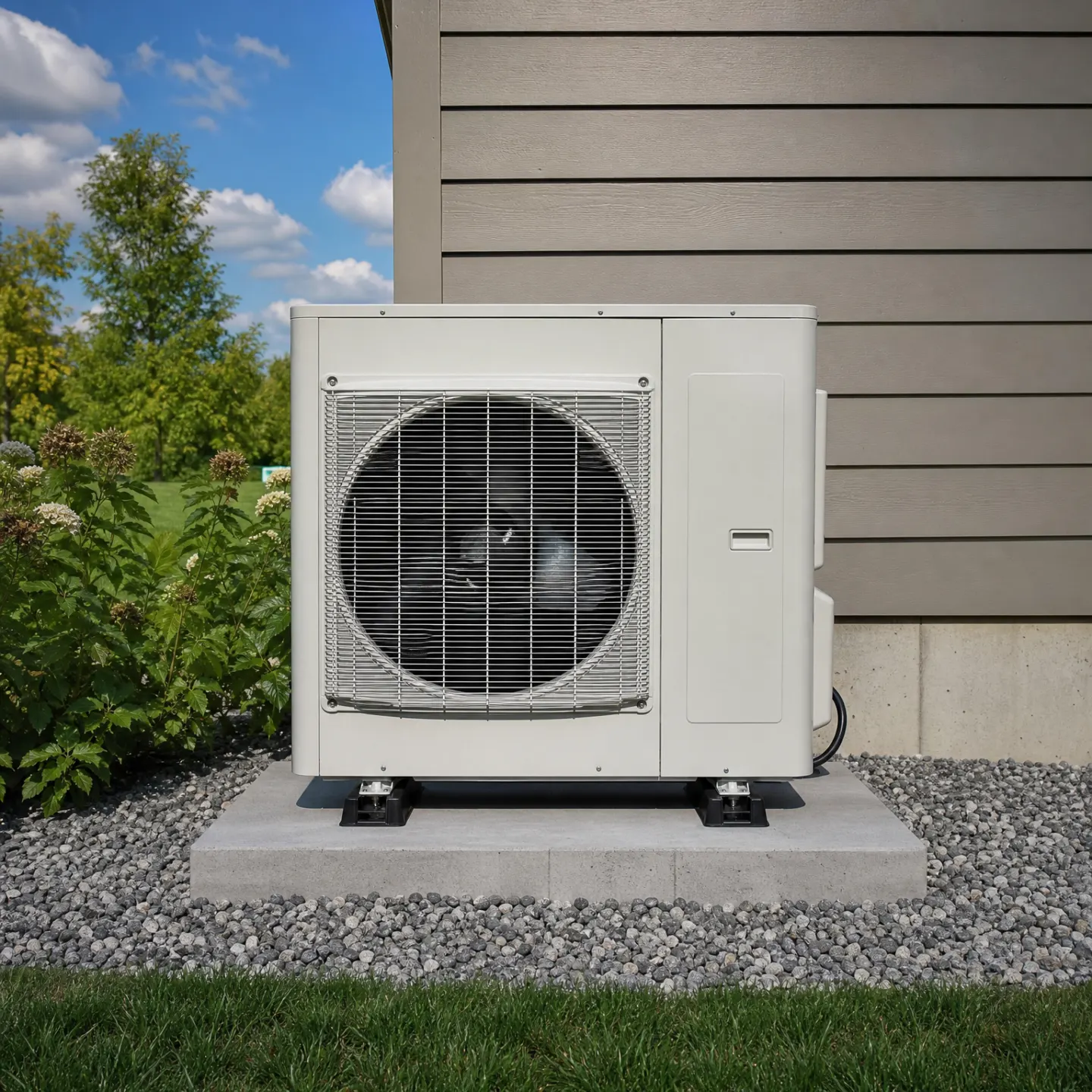
A white mini-split heat pump outdoor unit mounted on a concrete pad beside a gray-sided house, surrounded by gravel and green shrubs.

What to check before you call anyone

Before anyone comes out, there are a few things worth looking at. Check the thermostat is set to heat and the temperature is actually set above room temperature, not just on. Look at the outdoor unit and clear away any leaves, ice or snow blocking the coil or the fan. Check the air filter, a clogged one chokes airflow and can make the system struggle or ice up. Walk around the house and check that the vents are open and nothing is blocking them. Look at the circuit breaker for the outdoor unit and the air handler, a tripped breaker can look like a dead system. If the outdoor coil is caked in ice and it's not during a normal defrost cycle, that's worth noting for the tech rather than trying to chip it off yourself. None of this fixes a stuck reversing valve or a refrigerant leak, but it rules out the simple stuff before someone drives out to look at the complicated stuff.

A weak compressor pulls harder every hour it runs

Once a heat pump is low on charge or losing capacity, the compressor has to work past what it's built for to keep up. It draws more, runs hotter, and the extra strain wears the bearings and windings faster than normal operation does. A compressor that might have lasted years under a normal load can burn out in weeks once it's compensating for a different problem.

A blower straining against bad airflow can overheat

If a filter is clogged or a vent is blocked, the blower motor still tries to push the air it's told to push. That motor isn't built to run against that kind of resistance for long. Left running, it heats up past its normal range and can fail outright, turning a filter change into a motor replacement.

A heat pump rarely quits all at once. The first sign is usually weak heat, air from the vents that runs barely warm instead of hot, or a system that runs long stretches without catching up to the thermostat. Short cycling is another one, the system kicking on and off in quick bursts instead of running a normal cycle. Ice on the outdoor coil outside of a defrost cycle means something is already wrong, not something about to go wrong. A hissing or bubbling sound near the outdoor unit points to refrigerant escaping, and warm air blowing instead of hot, or cold air blowing in heat mode, often means the reversing valve isn't shifting the way it should. Any of these is worth a call. None of them get better by waiting.

Age on its own doesn't tell you much. What matters is which part failed and what else is close behind it. A reversing valve or a blower motor is a contained repair, the kind of part that gets replaced on its own without touching the rest of the system. A compressor is different. It sits at the center of everything, and on most heat pumps it costs enough on its own that putting a new one into an old outdoor unit means sinking money into a box that's already worn everywhere else. The other thing worth asking is how the system has been running lately, not just today. A unit that's had one issue in a long while is in a different spot than one that keeps coming back with something new. Repeated repairs on the same system usually mean it's wearing down generally, not failing in one fixable spot, and a tech can tell you honestly which situation you're in once they've seen the actual part that broke.